How to Customize Drinkware for Branding in China? The answer begins with purpose, not decoration. A branded tumbler must survive daily use, repeated washing, and changing customer preferences. Grand View Research valued the global reusable water bottle market at approximately USD 9.67 billion in 2023. Its report also forecasts continued growth through 2030. This trend creates opportunity for Chinese manufacturers, but demand alone does not guarantee a successful product.
The Advertising Specialty Institute’s Ad Impressions Study reports that drinkware can generate about 1,400 lifetime impressions per item in the United States. That figure gives every logo a practical responsibility. Paul Bellantone, former president and CEO of PPAI, has said, “Promotional products are the only advertising medium people thank you for.” The quote explains why usefulness matters. A bottle left unopened is not effective branding.
For companies learning how to customize drinkware for branding, China offers extensive production options. These include stainless steel vacuum bottles, Tritan tumblers, ceramic mugs, silicone sleeves, laser engraving, screen printing, and full-wrap sublimation. Material selection should match the audience and intended setting. A matte 500-milliliter bottle may suit office desks, while a rugged insulated flask may fit outdoor campaigns. Confirm food-contact documentation, factory quality systems, sample approval, packaging details, and applicable Chinese GB standards before production. Small details matter.
A supplier’s digital mock-up can look perfect. The physical sample may not. Ink can appear dull on curved surfaces, and laser marks can lose contrast on brushed steel. That is where experience matters. Branding is never only a logo. It is the moment a customer lifts the product, feels its weight, and decides whether it deserves another use.
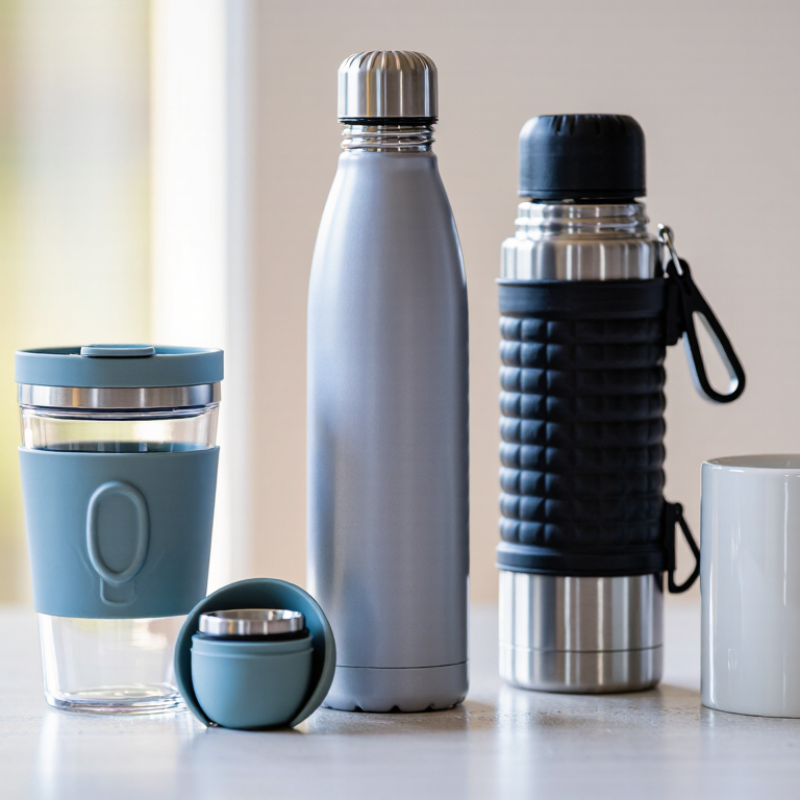
Custom drinkware in China is more than adding a logo. The product must satisfy material, safety, labeling, and production requirements. For cups, bottles, and tumblers, confirm the intended contact material first. Stainless steel, glass, plastic, silicone, and coatings may require different testing. Food-contact compliance should be supported by current test reports, supplier declarations, and traceable factory records. Do not rely on a general certificate. It may not cover the final product.
Branding details also need technical review. Check the print area, ink or coating durability, washing conditions, and color consistency. A logo that looks sharp on a sample may fade after repeated cleaning. It happens. Specify decoration methods, acceptable color variation, and inspection standards before mass production. Packaging should include accurate Chinese information where required, such as material details, capacity, manufacturer or importer information, and usage warnings. Requirements can differ by product type and sales channel, so a local compliance review is sensible.
Small details often create delays. A 500 ml bottle may hold slightly less after adding an inner coating. A tight lid may pass a visual check but leak during transport. Request pre-production samples and test them with hot water, cold drinks, drops, and repeated opening. Keep approval records for dimensions, artwork, materials, and packaging. One weakness remains common: teams approve appearance first and compliance later. That order can increase cost, waste, and rework.
| Customization Dimension | Common Options | China-Specific Requirement or Consideration | Recommended Quality Evidence | Indicative Planning Range |
|---|---|---|---|---|
| Drinkware Material | Stainless steel, glass, ceramic, plastic, silicone, or mixed materials | The applicable food-contact standard depends on the material. Common references include GB 4806.1 for general safety, GB 4806.5 for glass, GB 4806.7 for plastic, GB 4806.8 for ceramics, and GB 4806.9 for metal materials and articles. | Material specification, supplier declaration, migration-test results, and batch traceability records | Material confirmation: 3–7 working days |
| Capacity and Dimensions | Common capacities such as 350 ml, 500 ml, 600 ml, and 750 ml; custom height, diameter, and shape | The stated capacity should match the approved sample and product specification. Packaging dimensions should also be checked for transport and retail requirements. | Technical drawing, calibrated volume measurement, dimensional inspection report, and approved golden sample | Drawing and sample review: 5–10 working days |
| Logo Application | Screen printing, pad printing, laser engraving, heat transfer, embossing, or digital printing | Decorative inks, coatings, and adhesives should be suitable for the intended food-contact use and should not create unacceptable migration or odor risks. | Artwork proof, color approval sample, adhesion test, abrasion test, and food-contact assessment where applicable | Artwork proof: 2–5 working days; decorated sample: 5–12 working days |
| Color and Surface Finish | Matte, gloss, powder coating, metallic finish, transparent finish, or custom color matching | The coating should be compatible with the substrate, intended beverage conditions, washing method, and temperature range. Color matching should be approved using a physical sample rather than screen appearance alone. | Color reference, coating specification, surface adhesion test, scratch test, and dishwasher or washing-cycle test when relevant | Color sample approval: 5–10 working days |
| Lid, Seal, and Accessories | Screw lid, flip lid, straw lid, silicone seal, sleeve, handle, or carry loop | Materials that contact beverages should be evaluated under the relevant food-contact requirements. The design should also control leakage, detachable small parts, odor, and cleaning access. | Leakage test, torque or opening test, seal inspection, odor assessment, and repeated-use durability test | Functional sample testing: 5–10 working days |
| Thermal Performance | Single-wall, double-wall, vacuum-insulated, or heat-resistant glass construction | Temperature claims should be supported by test data and clearly limited to the tested conditions. Sudden temperature changes may create breakage or deformation risks for certain materials. | Temperature-retention test, heat-resistance test, thermal-shock test where applicable, and exterior-surface temperature check | Performance testing: 5–15 working days |
| Packaging and Labeling | Individual box, sleeve, gift set, barcode label, instruction card, and protective insert | Packaging information should be accurate and consistent with the product. For products sold in China, required Chinese labeling and applicable product information should be reviewed before printing. | Packaging artwork approval, barcode verification, drop test, carton inspection, and Chinese-language content review where required | Packaging proof: 3–7 working days |
| Food-Contact Compliance | Compliance review for the cup, lid, seal, coating, print, adhesive, and other beverage-contact components | A finished product may contain several materials, so each relevant component and its intended use should be assessed rather than relying only on the base material declaration. | Third-party laboratory report, declaration of compliance, raw-material documentation, and production-batch records | Compliance testing: commonly 2–6 weeks, depending on scope |
| Quality Control | Incoming-material inspection, in-process checks, final inspection, and pre-shipment sampling | Acceptance criteria should be agreed in writing, including allowable cosmetic defects, logo position, color tolerance, capacity tolerance, leakage performance, and packaging condition. | Inspection checklist, approved sample, defect classification, sampling plan, and corrective-action records | Final inspection: 1–3 working days per production lot |
| Production and Delivery Planning | Existing mold, modified mold, or fully custom mold; standard or customized packaging | Tooling, sampling, testing, production, inspection, and export documentation should be scheduled as separate project stages. Lead times vary by material, order quantity, decoration process, and testing scope. | Written production schedule, tooling confirmation, pre-production sample, inspection report, packing list, and shipping documents | Typical overall planning window: approximately 4–12 weeks after specifications are approved |
Note: Testing, labeling, and import requirements can vary according to material, product design, intended use, sales channel, and destination market. Confirm the current applicable standards and documentation requirements before mass production.
Stainless steel suits vacuum tumblers and travel bottles. It resists daily drops and supports engraving. Dark finishes may show fingerprints.
Borosilicate glass offers a clean, premium appearance and handles temperature changes well. However, it remains more fragile during shipping. Pack it carefully.
Yes, plastic can lower product weight and shipping expenses. Food-grade Tritan is clear and reusable. Request material documents, not only verbal assurances.
A slim 350-milliliter bottle fits office bags and car holders. Wide-mouth bottles are easier to clean and hold ice. Practical shapes usually perform better.
Inspect threads, seals, handles, coatings, and logo alignment. Test both hot and cold filling. Repeat washing matters. I once underestimated that detail.
Check the lid thread and silicone seal under realistic conditions. Test the filled product while standing and moving. A beautiful lid means little if it leaks.
Request material declarations, migration-test reports, and batch traceability records. Confirm requirements for steel, plastic, silicone, inks, and adhesives. Paperwork can delay clearance.
Include tooling, samples, inspections, packaging, duties, and replacement units. Set tolerances for dents, print shifts, leaks, and color variation. Add delivery time.
A digital mock-up cannot reveal odor, weak threads, or poor coating adhesion. Compare the finished sample with actual production conditions. Samples can still mislead.
Yes, build time for rework and unexpected factory delays. Delivery dates may look exact, but schedules can change. A buffer is safer.
Learning how to customize drinkware for branding in China begins with defining your target audience, usage scenarios, budget, order quantity, and functional requirements. Choose suitable materials such as stainless steel, glass, ceramic, or food-grade plastic, then select product styles that match your brand image and local consumer preferences. Logo placement, color selection, typography, and packaging should be planned carefully to create a clear, attractive, and culturally appropriate presentation for the Chinese market.
Next, compare customization methods such as screen printing, laser engraving, heat transfer, and full-color printing according to the material, design complexity, durability, and quantity required. Work with a reliable manufacturing partner that can provide samples, transparent pricing, production timelines, and responsive communication. Before launch, inspect product quality, confirm material safety and labeling compliance, review packaging details, calculate total costs, and allow sufficient time for production, inspection, and delivery. A structured process helps reduce risks and ensures consistent, market-ready drinkware.

 Calmora Bottle