Choosing food containers in 2026 means balancing safety, durability, convenience, and environmental impact. Glass resists staining and keeps flavors neutral, but it can break and weighs more. Stainless steel is sturdy and useful for transport, though it is not microwave-safe. Plastic is light and versatile, but its performance depends on the resin, design, and care instructions. Paper and molded fiber suit some short-term uses, yet moisture can limit their practicality. There is no universal winner.
The scale of packaging waste makes material choices worth examining. The OECD’s Global Plastics Outlook (2022) reports that packaging represented about 40% of plastic waste generated worldwide in 2019. That figure covers packaging broadly, not food containers alone. The UN Environment Programme’s Food Waste Index Report 2024 estimates that 1.05 billion tonnes of food were wasted in 2022 across households, food service, and retail. Better storage may help in some settings, but this figure does not prove that any container material prevents food waste.
So, what materials are best for food containers? The answer depends on what you store, how often you reuse a container, and how it will be cleaned and heated. A glass dish may work well for leftovers at home; a lightweight, durable option may make more sense for a packed lunch. Look for clear food-contact information and follow the manufacturer’s care guidance. Small details matter. This comparison will weigh practical strengths and trade-offs without pretending one material is best for every kitchen. Some evidence also has limits: environmental results can change with local recycling systems and actual reuse habits.
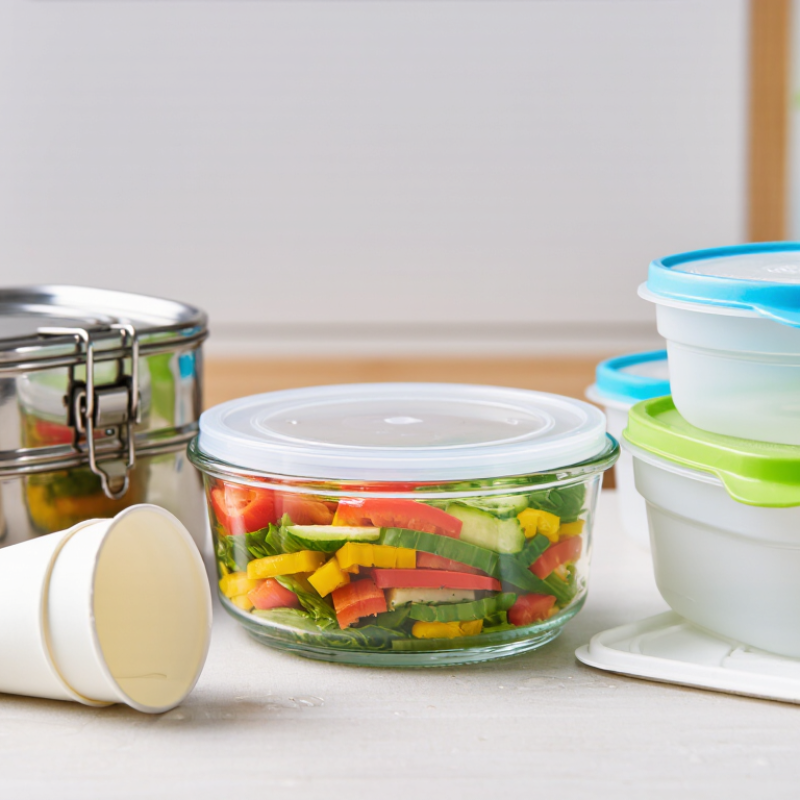
Food containers need to match the food, temperature, and storage time. Glass resists staining and odors, and its smooth surface is easy to clean. It also lets you see leftovers at a glance. But glass is heavy and can break if dropped. Not ideal for every commute.
Stainless steel is light, durable, and useful for dry foods or packed lunches. It does not suit every situation: many steel containers cannot go in a microwave, and lids may affect leak resistance. Plastic containers are lightweight and convenient, but their heat tolerance varies by material. Check the container’s intended use, especially before heating oily or acidic foods. Scratches and clouding can make cleaning harder over time.
Silicone bends for compact storage and can form a flexible seal, though food residue may cling to its surface. Paper or molded-fiber containers are light and often suited to short-term serving, but moisture can soften them.
A container’s most useful properties include a secure lid, easy-to-clean corners, and resistance to odors and stains. Consider how it feels in daily use: a lid that is difficult to close may be less practical than a sturdier material. There is no perfect choice. Inspect worn containers regularly, and replace them when cracks, warped edges, or damaged seals interfere with cleaning or closure.
Material choice affects more than durability; it shapes what touches food, how containers handle heat, and whether they suit acidic or oily meals. Glass is nonporous and works well for tomato sauce, but it is heavy and can break when moved from freezer to oven. Stainless steel is sturdy for transport, though it is usually unsuitable for microwave reheating. Plastic varies by formulation and intended use. The FDA notes that food-contact substances must be authorized for their specific conditions of use; a container’s appearance alone cannot confirm heat compatibility. No material is perfect.
Tips: Check the container’s temperature and use markings before heating or freezing. Replace cracked plastic, chipped glass, and badly scratched surfaces. Keep lids in mind: they may use a different material than the container.
Compatibility also depends on the food. Acidic dishes, such as citrus or tomato, need containers intended for repeated contact with such foods. Avoid heating plastic unless its instructions explicitly allow it. The OECD’s Global Plastics Outlook reports that packaging accounted for about 40% of plastic waste generated in 2019. That figure is not a safety measure, but it underlines why reuse matters. In practice, choosing one container for every task is tempting, yet a glass dish for reheating and a light, food-contact-rated container for packing may be the more reliable pairing. Check the specific use, not just the material name.
Representative thermal conductivity of common container materials
Thermal conductivity indicates how readily heat passes through a material: lower values generally mean slower heat transfer, while higher values mean faster heat transfer. Approximate values shown are in W/m·K and vary by material grade and conditions. Conductivity alone does not determine food safety: choose food-contact-compliant containers and follow the maker’s temperature and use instructions.
Glass, stainless steel, plastic, and silicone each solve a different storage problem.
Glass keeps odors and stains at bay, and its clear walls make leftovers easy to spot. Glass stays inert. But it breaks, weighs more in a lunch bag, and can crack after sudden temperature changes.
Stainless steel is sturdy, lightweight, and useful for packed meals, though you cannot microwave it. It also hides the food inside. That trade-off matters.
Plastic is light, inexpensive, and often microwave-safe when its label permits; worn or warped containers deserve replacing.
Silicone folds into tight drawers and handles flexible storage, but it may retain oily smells and can feel floppy when full.
No material wins every kitchen test.
The U.S. EPA’s 2018 municipal waste data reported recycling rates of 31.3% for glass containers and packaging and 13.6% for plastic. These figures cover broad packaging categories, not food containers alone.
The International Stainless Steel Forum reports an end-of-life recycling rate above 80% for stainless steel products, though actual collection varies.
Recycling figures matter, but daily reuse, careful cleaning, and choosing the right container for hot or acidic food matter too. I would still choose glass for saucy leftovers and steel for a bumpy commute.
What Are the Best Materials for Food Containers in 2026?
Choosing Materials for Different Foods and Storage Needs
The right container depends on the food, temperature, and how long it will be stored. Glass suits tomato sauce, citrus, and strongly scented leftovers because it resists staining and odor retention. Glass stays neutral. Choose a container marked safe for your intended use, and check whether its lid can handle heat. A full glass container can also be heavy, especially when packed for lunch.
Stainless steel is sturdy and useful for dry snacks, chopped vegetables, or meals carried on the go. It does not belong in a microwave, so transfer food before reheating. For soups, a well-sealed lid matters as much as the container material. Test it upright before putting it in a bag; a tiny leak can make a big mess.
Food-grade plastic is lightweight and practical for cold lunches, but use only containers labeled for the food and temperature involved. Don’t assume an old takeout tub is suitable for repeated heating. Silicone can fold down for storage and handle freezer use when labeled accordingly, though it may hold odors or feel harder to clean at its seams. No material is perfect. Match the container to the task, and replace pieces that are cracked, warped, or no longer seal well.
| Material | Best Suited Foods | Storage Strengths | Microwave, Freezer & Oven Use | Limitations to Consider | A Good Choice When… |
|---|---|---|---|---|---|
| Glass | Soups, sauces, leftovers, acidic foods, and foods with strong aromas or colors | Nonporous, does not readily retain odors or stains, and makes food easy to see | Microwave use is generally suitable for microwave-safe glass without a metal lid. Oven use depends on the glass and container label. Many glass containers can be frozen, but allow room for food to expand. | Heavier and breakable. Sudden temperature changes can cause thermal shock; ordinary glass is not automatically oven-safe. | You want a reusable container for refrigerated leftovers and reheating, and weight or breakage risk is not a concern. |
| Stainless Steel | Dry snacks, cut fruit, sandwiches, salads, and packed meals | Durable, lightweight for its strength, opaque, and resistant to many everyday impacts | Do not use in a microwave. Freezer suitability depends on the container design and lid; leave expansion space for liquids. Oven use is product-specific. | Food cannot be seen through it; acidic or salty foods may be unsuitable for prolonged storage in some grades or designs. Not microwave-compatible. | You need a sturdy, portable container and do not need to microwave food in it. |
| Food-Grade Silicone | Flexible portions, snacks, freezer portions, and collapsible storage | Flexible and lightweight; many products are designed to fold or collapse and resist breaking | Microwave, freezer, and oven suitability varies by product. Follow the stated temperature limits and use instructions; do not assume all silicone containers are oven-safe. | Can be less rigid than hard containers, and some products may retain odors or greasy residues. Quality and temperature ratings vary. | You value flexibility, compact storage, or a container that can accommodate a range of temperatures when its label permits. |
| Polypropylene (PP, recycling code 5) | Everyday leftovers, meal-prep portions, and packed lunches | Lightweight, relatively tough, and commonly used for reusable food-storage containers | Some PP containers are microwave- and freezer-safe, but suitability depends on the specific product. Check its label and remove or vent the lid as directed. | May scratch, stain, or retain odors over time. Heat tolerance is product-specific, and damaged or warped containers should be replaced. | You want an affordable, lightweight option for routine storage and the container is explicitly labeled for your intended use. |
| High-Density Polyethylene (HDPE, recycling code 2) | Cold foods, dry ingredients, and larger-volume pantry or refrigerator storage | Lightweight and impact-resistant; widely used in food packaging and storage applications | Microwave and oven use should not be assumed. Freezer performance depends on the container design and product instructions. | Usually opaque and less suitable for reheating than microwave-labeled containers; not all HDPE items are designed for repeated food-storage use. | You need a practical container for cold or dry storage and the item is clearly intended for food contact. |
| Paperboard with a food-contact lining | Takeout meals, bakery items, sandwiches, and short-term dry or chilled storage | Lightweight and easy to handle; some formats are designed for single-use service or transport | Microwave or freezer use depends on the lining, coatings, adhesives, and product label. Do not put it in an oven unless specifically approved. | May soften or leak with moisture or oily foods; linings can affect recyclability. Not generally designed for repeated washing and reuse. | You need short-term packaging or convenient transport rather than a durable, reusable container. |
Practical tip: Choose containers specifically labeled for food contact and for the intended appliance or temperature. Check the lid separately, avoid sudden temperature changes with glass, and leave headspace when freezing liquids. Material alone does not guarantee that a container is microwave-, oven-, or freezer-safe.
A container’s environmental impact depends on how long it lasts, how often it is reused, and what happens after disposal. The OECD’s Global Plastics Outlook (2022) estimates that only 9% of plastic waste was recycled globally in 2019. That makes repeated use important, but a container must stay intact and be cleaned properly to earn its keep. Glass resists stains and odors, yet it is heavy and can break during daily commutes. Stainless steel is durable and light for its strength, though its production has a significant footprint. Food-grade plastic is light and practical, but scratches and warping can shorten its useful life.
Recycling matters, but local collection systems vary. The International Aluminium Institute reports that recycling aluminum uses about 95% less energy than producing primary aluminum. That advantage depends on the container actually being collected and recycled. Reuse also has trade-offs: washing uses water and energy, and the break-even point varies with transport, cleaning, and the number of uses. I’d avoid declaring one material the winner. A sturdy container used for years may outperform a recyclable one replaced every few months.
Tips: Choose a leak-resistant size you’ll carry daily. Check care instructions, especially for lids and seals. Replace damaged containers, and confirm that your local program accepts the material. A small habit matters.
It depends on the food and how you use the container. Glass resists stains, while steel handles daily transport well. No material is perfect.
No. Check its temperature markings before heating or freezing. Moving glass directly from a freezer to an oven can cause breakage.
It is sturdy for carrying meals, but usually unsuitable for microwave reheating. Use a different dish when needed.
Plastic types vary. Heat plastic only when its instructions allow it. For repeated contact with tomato or citrus dishes, choose a container intended for acidic foods.
Yes. Lids and seals may use different materials than the container. Check their care and temperature instructions, too.
Replace cracked plastic, chipped glass, and badly scratched surfaces. Warping can also shorten a plastic container’s useful life. I still find small scratches easy to overlook.
Not automatically. Its impact depends on how long it lasts, how often you use it, and how it is cleaned. Washing also uses water and energy.
A light, leak-resistant container that fits your routine may be the practical choice. Glass can feel heavy on a commute, while damaged seals can make any container troublesome.
No. Local collection rules vary, so check whether your program accepts that material. Recycling helps only when the container is collected and processed.
Choosing what materials are best for food containers depends on how they interact with food, how the containers will be used, and how long they are expected to last. Glass is nonporous and useful for storing many foods, while stainless steel is sturdy and suitable for meals on the go. Plastic is lightweight and convenient, but its care instructions and intended uses should be checked. Silicone is flexible and space-saving, making it practical for certain storage needs. No single material is ideal for every purpose.
Consider the food’s temperature, acidity, moisture, and storage duration when selecting a container. Durable materials that can be reused may reduce the need for frequent replacements, but their overall environmental impact also depends on how they are made, maintained, and eventually discarded. Matching the material to the food and routine can help balance safety, convenience, longevity, and responsible use.

Calmora Bottle